
Senior Sofiya Frey highlights her experiences at SHS and sheds life on life in war-torn Ukraine
By Grace Pearson, Editor-in-Chief
April 18, 2025
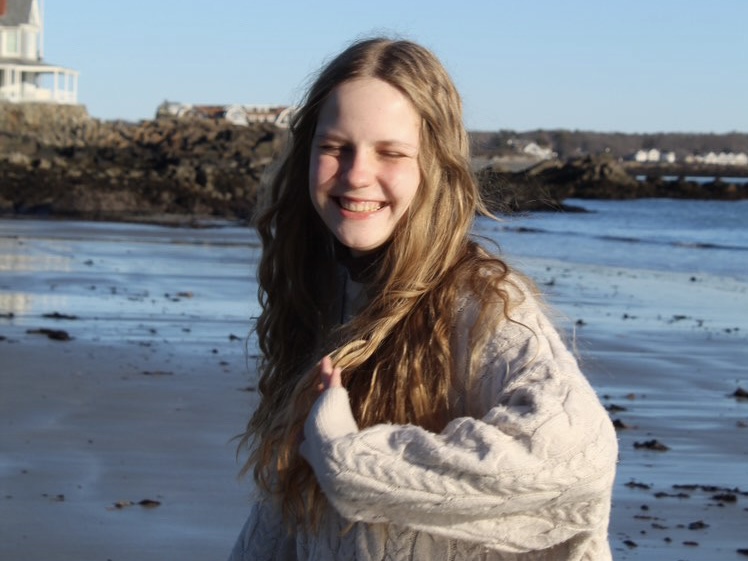
SANFORD, Maine – Sofiya Frey is a senior at Sanford High School and an exchange student from Ukraine. She spent the first semester at Massabesic High School, and has been attending SHS since the start of second semester.
While she has been very excited and grateful about the experience, she was able to determine a lot of differences between American and Ukrainian schools. For example, Schools in Ukraine start at nine a.m., and she does not like how early our classes start.
Students in Ukraine stay with the same group of students all day long from elementary through eleventh grade and they have different teachers for different classes when they reach fifth grade. All grade levels are in one building. Frey said the students “become like siblings.”
Ukraine does not have as many different classes, especially when it comes to being creative. There are no school sports or clubs, students have to find somewhere to do it on their own. All subjects are chosen for the student until they go to a specialized school after ninth grade. These specialized schools are considered to be a college, similar to SRTC.
Frey says that home life is also very different in Ukraine. You never have shoes in the house. Children, especially older siblings, carry a lot of responsibility. It is normal for a parent to go away for a week while the older child watches the siblings. It’s also not common for people to have divorced parents, as it’s normally frowned upon.
Openly talking about politics is a part of daily life in Ukraine. They also do not have taxes in stores, and Frey was very confused about why that exists here.
Another large difference is the lack of consumer culture in Ukraine compared to the US. “It’s not common to go and get a coffee somewhere every day,” said Frey. It is common to eat at home and save as much money as possible. This is a large contrast to many students’ connections to local coffee spots and fast food restaurants.
“It’s also because of how we were influenced by the U.S.S.R. and how poor we were raised,” said Frey. “You had to save every penny in Communism, and since you would consider that a generational trauma, it has passed down to me for example, but it will probably not pass down to the next generation. I still feel it from my grandma and my mom, who had spent time living in the U.S.S.R.”
The War with Russia
Trigger Warning: this section of the article contains harsh or graphic language relating to war, death, rape, and more.
Frey has dreamed of attending an American High School since she was eight years old. However, life as an exchange student is not all glamor — as a native of war-torn Ukraine, Frey worried her opportunity to study in the US would be affected. She never thought she would be here under the circumstances and hopes to bring awareness to the reality the Ukraine is currently experiencing.
Schools from the eastern side of Ukraine have been destroyed, and many have been rebuilt into Russian schools. “What they’re teaching kids is very bad,” she said. Towns on the eastern border are bombed every day. It’s very common in Central Ukraine that you still go to school if there is a shelter.
“Ukraine says more than 19,000 children have been illegally taken by Russia since the war began,” said National Public Radio. Frey says that the kidnapped children are “being brainwashed” in Russia. She says it is not shown here in the media.
“It’s way harder to learn when you get constant air alarms,” said Frey. “You never know if you’re going to go downstairs and have to get out through an already destroyed school.” If they don’t have enough shelter space at the school then students only go for part of the day, some of their days are online. Russia has destroyed many schools and children’s hospitals, even in Kyiv, the capital of Ukraine.
Besides preventing Ukrainians from practicing their culture, the Russian government also continues to attack the civilians. “We also had mass shootings,” said Frey. There was a mass shooting that took out 43 people, and it was under a minute of shooting. It was just artillery.”
“They had the Bucha massacre happening, and it was just a bunch of Russian soldiers raping and killing our civilians, our children and our women and men, and they were not even soldiers,” said Frey. “It was all over town, a bunch of dead bodies who have been raped and destroyed.” She escaped through those destroyed cities with her family. As they were driving out, tanks were driving in. A week later the bridge they drove on was destroyed so the Russian tanks couldn’t get out.
They also target civilians, hospitals, schools and civilian homes for bombings. “We had a lot of people dead, and it’s mostly civilians. They take civilians hostage. They rape them,” said Frey. Frey was worried that while she was an exchange student in the U.S., something bad would happen to her family members.
“I don’t think I know anyone who lost nothing. I have a lot of people that I lost. I have places that I lost and I have property that I lost. I know a lot of people who lost way more than I did. The hardest part was definitely not knowing if I’d have a place to come back to, and whether my family would still be alive when I came back. And I’m still wondering, in the three months I have left here, if something’s going to happen to them, and something might happen any day. That was probably my biggest fear.”
It will soon be a year since Frey lost her friend who was a war medic. “It’s going to be a hard period of time for me. You always have somebody that you lost. I know a few people that I lost personally and I know my friend whose whole family are soldiers. It’s rough. We have a lot of problems in our country but I don’t think it’s necessarily the American’s responsibility to solve them. We have linguistic problems in our country, we have other problems in our country, we have free speech problems, we have many problems. But when the war is happening there’s nothing more important than saving the lives of our people and fighting for our liberty and democracy. That was what we did for hundreds of years since the Russian Empire had occupied us. That we have been doing always. Our young people, our older people, everyone.”
Perseverance
Despite the hardships, many Ukrainians are still finding ways to persevere. “We are getting judged largely that our people are still living life even under war, and I want to say that if we didn’t, we would all realize what depression we’re in. And having fun and living your life, you just need it to survive. Because we’re already having so many external factors. And we need to have fun, everyone does. It’s completely fine that we do,” said Frey.
“We do need a lot of help, you can donate and it’s very important. I hope people donate. We need money. It’s not like I’m here begging on my knees. My home was destroyed. I don’t want to see that happen to other homes. I don’t want to see that happen to my friends. When you donate money you’re saving civilians, and it all goes to the warfront.”
She hopes that people will become more aware of her people’s situation and help them continue to persevere in the future.
 The Spartan Times